
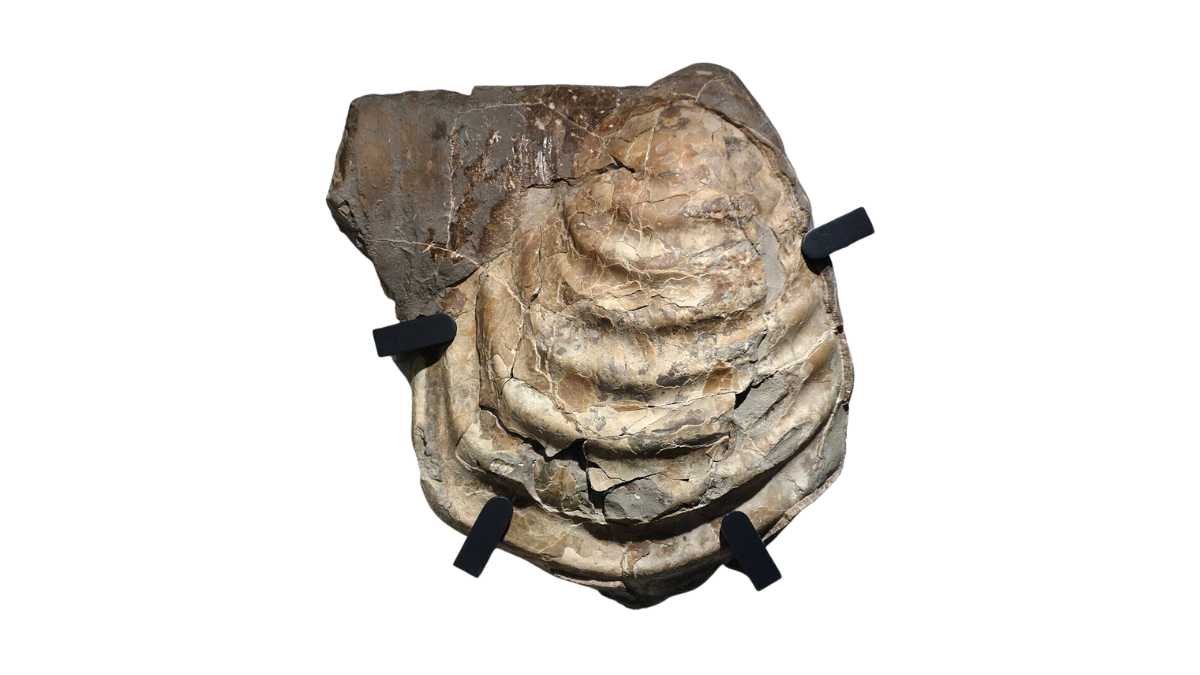
In the middle of Queensland’s dry outback, a traveler hunting for stones picked up what looked like a perfectly round pebble. It wasn’t a pebble at all. Researchers say it’s a fossil pearl from a giant Cretaceous clam roughly 100 million years old and the largest of its kind reported in Australia. The image on page 1 of the file shows a massive Inoceramus shell on museum display, the kind of clam family that could have made such a prize.
The pearl, a bit bigger than three-quarters of an inch across, turned up at Kronosaurus Korner in Richmond, a town that once sat under the shallow Eromanga Sea. A neutron scanning study confirms the sphere is a true pearl formed inside a long-gone bivalve, offering a tiny, gleaming time capsule from when marine reptiles ruled those waters.
Who conducted the study?
The verification effort was led by Gregory Webb, a geoscientist at the University of Queensland, after Kronosaurus Korner curator Michelle Johnston asked him to take a closer look. Webb then teamed up with instrument scientist Joseph Bevitt at the Australian Nuclear Science and Technology Organisation, which operates high-energy imaging tools suited to peering inside dense objects without cutting them open.
The story first appeared in a Phys.org news report summarizing the team’s announcement. In short, an amateur find became a lab case study, with specialists confirming the object’s internal structure matches that of a pearl rather than a mineral concretion.
What the researchers did
To avoid damaging the sphere, the team used a Dingo neutron-CT scanner, a device that maps the inside of objects using neutrons instead of X-rays. That lets them “slice” the pearl virtually and look for the layered signature that forms when a clam coats an irritant, one ultra-thin shell at a time.
Neutron imaging is ideal for fossils trapped in tough rock because it can reveal textures and growth bands that X-rays sometimes miss. Here, it showed the smooth concentric build-up scientists expect from nacre forming around a grain or parasite inside a shell.
What they discovered
Experts concluded the sphere is indeed a pearl from an ancient relative of Inoceramus, a clan of clams so big some shells stretched to about six and a half feet across. Those heavyweights lived in the Cretaceous seas and, like modern mollusks, calmed irritants by wrapping them in mineral layers, the same soothing reflex that makes pearls today.
At just over three-quarters of an inch, this is the largest fossil pearl identified in Australia so far. That’s not record-shattering by jewelry standards, but it is rare for paleontology, where intact pearls are scarce because they’re small and easily lost during fossilization.
Why is it important?
A pearl is more than a pretty bead; it’s a stress diary. Each layer records how a clam responded to its environment, from grit to parasites to sudden changes in the water. Reading those layers offers clues about ancient seas, including chemistry and seasonal rhythms in a part of Australia that is desert today.
Finds like this also link museum visitors to geological timescales in a single glance. A round, familiar object can open a conversation about vanished oceans, giant clams, and the marine reptiles including the kronosaur that cruised the Eromanga Sea above what is now Richmond.
The team behind the find
The pearl surfaced at Kronosaurus Korner, a local museum and working fossil digsite that encourages careful collecting in the surrounding Cretaceous sediments. That community-science pathway is how a casual “fossicker” ended up holding something extraordinary.
From there, specialist labs at ANSTO and analysis led by the University of Queensland bridged the gap from curiosity to a confirmed fossil. It’s a neat chain: find in the field, verify in the lab, and share the story with the public through museum displays and science media.
Warnings to keep in mind
The team notes that the formal study has not yet appeared in a peer-reviewed journal. The identification is solid enough for a public announcement, but the finer points like growth rates or chemistry will need the full paper for experts to pick apart.
That caution doesn’t dull the shine. Whether mounted in a case or scanned in slices, this pearl brings the ancient seabed into sharp focus proof that even a tiny sphere can hold an ocean of stories.
Credit: Wikimedia CommonsDaderot Creative Commons CC0 1.0 Universal Public Domain Dedication.